
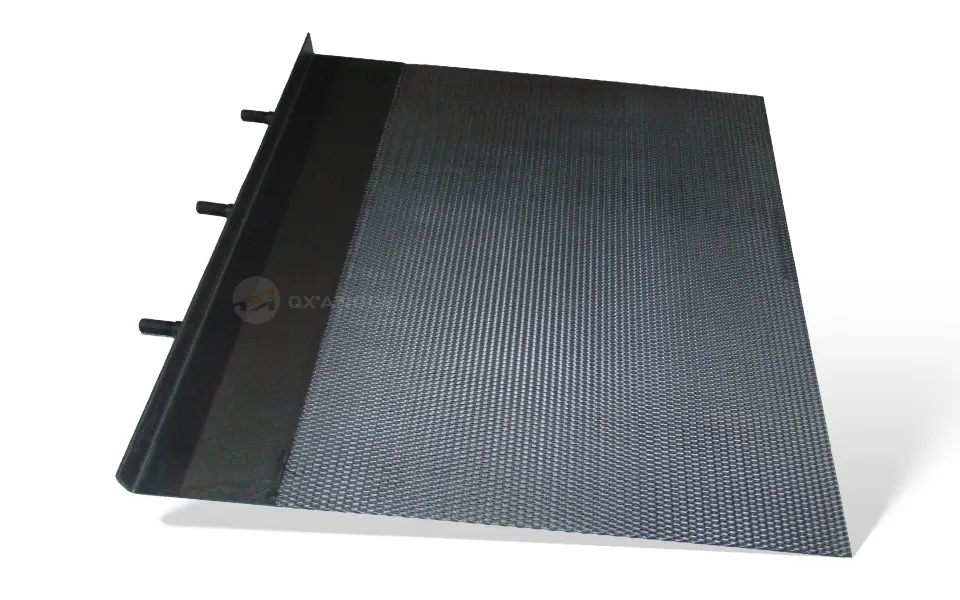

Titanium anodes for organic synthesis determine reaction efficiency, product purity and production cost in the field of organic electrolytic synthesis. Titanium anodes for organic electrolytic synthesis (also known as MMO/DSA anodes) adopt industrial pure titanium as the substrate and precious metal oxides as the catalytic coating. With core advantages such as corrosion resistance, high selectivity and long service life, they have become the preferred anode products in the modern organic electrolytic synthesis industry and are widely applied in the electrolytic preparation of various organic compounds.
Product Structure of Titanium Anode for Organic Synthesis
Titanium anode for organic electrosynthesis adopt a composite structure of “substrate + catalytic coating”, which balances mechanical strength and electrocatalytic performance. Their materials and specifications can be customized according to the requirements of different working conditions, making them suitable for various organic electrolysis reaction scenarios.
- Substrate Material
Gr1/Gr2 industrial pure titanium is selected as the substrate, which can be processed into various structures such as plate, mesh and porous forms. It not only exhibits excellent corrosion resistance to withstand concentrated acids, alkalis and various organic solvents during organic electrolysis, but also possesses sufficient mechanical strength with low deformation tendency. This ensures a constant electrode distance and uniform current distribution throughout the electrolysis process, thereby guaranteeing the stable progress of the reaction. - Catalytic coating
The catalytic coating is the core of the titanium anode. Adopting nanocrystalline refinement technology, it features strong bonding force with the substrate and excellent electrocatalytic activity. The coating formula can be customized according to the electrolyte system and reaction type to achieve targeted performance enhancement.
Iridium series (IrO₂-Ta₂O₅): The preferred coating for acidic systems, featuring low oxygen evolution overpotential and excellent strong acid resistance. It is widely applied in the electrolytic synthesis of carboxylic acid compounds such as succinic.
Ruthenium-based system (RuO₂-IrO₂-TiO₂): Suitable for chlorine-containing systems, it can effectively inhibit the oxygen evolution side reaction, significantly improve the selectivity of the target reaction, and is applicable to the electrolytic preparation of chlorine-containing organic compounds.
Platinum series/lead dioxide: It features a high oxygen evolution potential. For the electrolytic synthesis of refractory organic compounds, it can precisely catalyze the targeted oxidation reaction and improve product yield.
Application of Titanium Anodes for Organic Electrosynthesis
Titanium anode for organic electrosynthesis, featuring customized coating design and excellent comprehensive performance, are widely applied in the electrolytic preparation of various organic compounds and compatible with multiple reaction types, covering the following core scenarios.
- Carboxylic Acid Synthesis: Electrolytic preparation of organic carboxylic acids such as succinic acid, glyoxylic acid and oxalic acid, featuring high reaction efficiency and high product purity.
- Synthesis of Nitrogen-Containing Compounds: Electrolytic production of nitrogen-containing organic compounds such as Tetrabutylammonium Bromide and caprolactam intermediates.
- Organic oxidation reactions: oxidation of alcohols to aldehydes/ketones, aromatic hydrocarbon oxidation, epoxidation reactions, Kolbe coupling and other types of oxidation reactions.
Application Principle of Titanium Anode in Organic Electrolytic Synthesis
Electrochemical Reaction Mechanism
The electrochemical reaction process of titanium anodes in organic electrosynthesis mainly involves oxidation and reduction reactions, and its core mechanism lies in the conversion of organic compounds realized through electron transfer on the electrode surface. In oxidation reactions, titanium anodes serve as anode materials. Under the action of an applied electric field, organic molecules in the electrolyte lose electrons on the electrode surface to form oxidation products. This process is usually accompanied by proton transfer, generating stable reaction intermediates or final products. For instance, in the oxidation of alcohols to aldehydes or ketones, the active sites on the surface of titanium anodes can efficiently promote the dehydrogenation of hydroxyl groups, thus producing target products. In reduction reactions, titanium anodes accept electrons to reduce organic molecules to a lower oxidation state, such as the reduction of carbonyl groups to hydroxyl groups or nitro groups to amino groups. Such reduction processes generally require a high overpotential, and the excellent electrical conductivity and stability of titanium anodes provide a favorable reaction platform for this process. In addition, coating materials on the surface of titanium anodes (such as noble metal oxides) can significantly enhance the catalytic performance of the electrode, reduce the reaction activation energy, and thereby improve reaction efficiency. Studies have shown that the active metal oxides in the coating can participate in electrochemical reactions through lattice oxygen, further optimizing the reaction pathway and improving reaction selectivity.
Principle of Catalysis
The catalytic effect of the coating on the surface of titanium anodes in organic reactions is mainly reflected in its adsorption and activation capacity for reaction intermediates. The active sites in the coating are usually provided by noble metal oxides such as IrO₂ and RuO₂. These active sites can form transition state complexes with reactant molecules through electron transfer or chemical bonding, thereby lowering the reaction energy barrier and accelerating the reaction rate.
Influencing Factors
The electrocatalytic performance of titanium anodes in organic electrosynthesis is affected by various factors, among which current density, electrolyte composition and temperature are three key parameters.
- Current density directly affects the electron transfer rate on the electrode surface, thereby determining the progress of the reaction. At a relatively low current density, the reaction on the electrode surface proceeds mildly with high selectivity and yield. When the current density is excessively high, electrode polarization intensifies, which may trigger side reactions and consequently reduce current efficiency.
- The composition of the electrolyte also has a significant impact on the catalytic performance of titanium anodes. Additives in the electrolyte, such as supporting electrolytes and organic solvents, can optimize reaction conditions by altering the solubility and diffusion rate of reactants.
- Temperature is another crucial factor affecting electrocatalytic performance. Raising the temperature can generally accelerate the reaction rate, yet it may also cause the dissolution or degradation of coatings on the electrode surface, thereby reducing its long-term stability. Studies have shown that for different types of organic reactions, the optimal reaction temperature usually needs to be optimized according to the specific reaction system.