
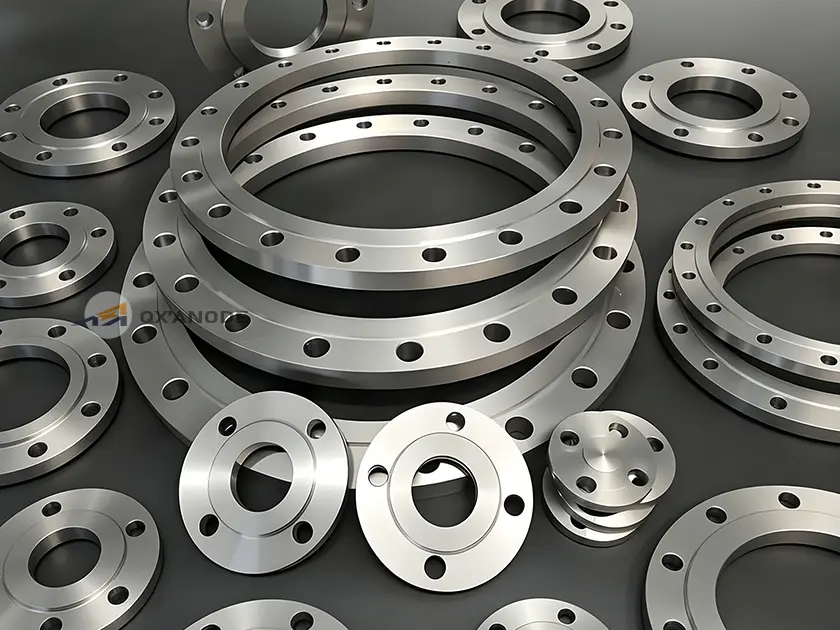
Technical Analysis of Titanium Flanges for Chemical Industry
Performance, Standards and Typical Application Scenarios
In the fields of chemical engineering, marine engineering and high-end manufacturing, the sealing performance, corrosion resistance and long-term operational reliability of piping systems are crucial. As a key connecting component, titanium flanges have become the preferred solution for working conditions with stringent requirements such as strong corrosion, high cleanliness or lightweight design, thanks to their excellent comprehensive properties.
Product Features and Material System
Titanium flanges are pipeline connection components made from industrially pure titanium or titanium alloys as the base material, achieving sealed connections through bolt fastening and gasket fitting. Their core advantages stem from the intrinsic properties of titanium metal:
- Low density and high specific strength: Titanium has a density of approximately 4.5 g/cm³, about 56% that of stainless steel. Under the same pressure-bearing conditions, the weight of titanium flanges can be reduced to around 45% of that of stainless steel flanges (e.g., a DN100 flange weighs about 1.2 kg versus 2.7 kg), significantly lowering the load on the piping system.
- Excellent corrosion resistance: It remains stable in media containing chloride ions, wet chlorine gas, nitric acid, hydrochloric acid, etc. For example, TA10 (Ti-0.3Mo-0.8Ni) is suitable for reducing acid environments, and TA9 (Ti-0.2Pd), with the addition of trace palladium, shows a significantly improved resistance to crevice corrosion.
- Excellent thermal stability: The operating temperature can reach 300℃, and some specially treated flanges can withstand higher temperatures.
- Non-magnetic and biocompatible: Suitable for electromagnetically sensitive environments and occasions with high cleanliness requirements.
Common grades of titanium flanges for chemical industry
Commercially pure titanium: Gr1, Gr2, featuring excellent ductility, suitable for low-pressure applications or gasket cladding layers.
Alloy Series: TC4 (Ti-6Al-4V) with a tensile strength of ≥900 MPa, used for high-load flanges and bolts; TA10 and TA9 are specially designed for highly corrosive working conditions.
Technical Parameters and Manufacturing Standards of Titanium Flanges for Chemical Industry
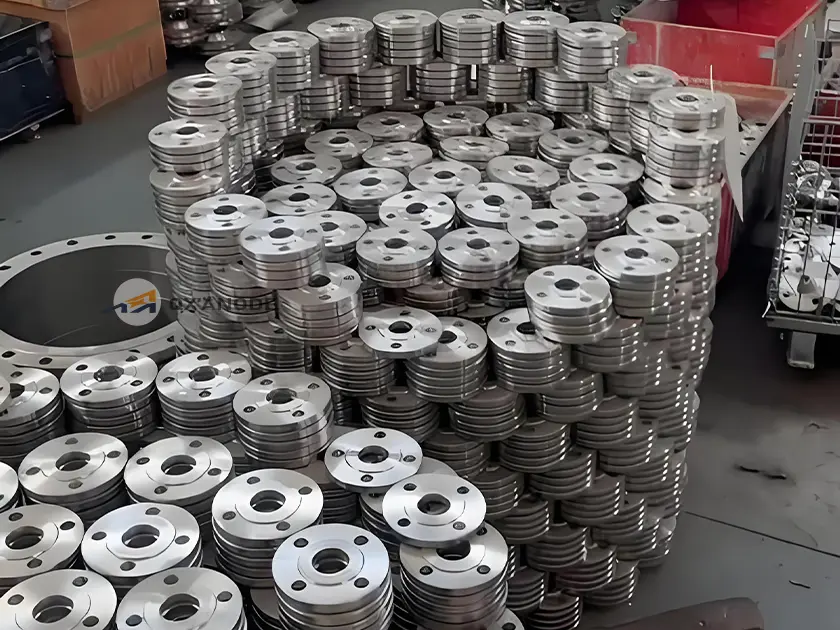
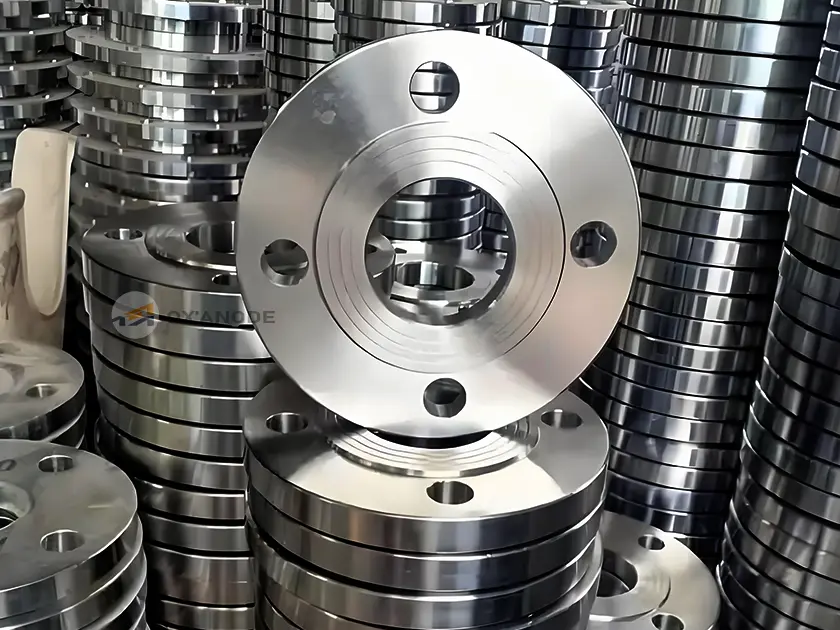
Performance Indicators of Titanium Flanges for Chemical Industry
- Sealing performance: The roughness of the sealing surface is Ra ≤ 0.8 μm, meeting the requirements of ISO 5208 Class VI sealing.
- Pressure rating: In accordance with ASME B16.5, up to Class 2500 (PN40), applicable pressure ≤ 40 MPa.
- Corrosion resistance life: In seawater environment, critical pitting temperature ≥ 80℃ (ASTM G48), design life exceeds 25 years.
Standard System for Titanium Flanges for Chemical Industry Use
The manufacturing and acceptance of titanium flanges shall comply with international standards.
- International standards: ASME B16.5 (Dimensions and Pressure Ratings), ASTM B381 (Titanium Forgings), ISO 7005-1.
- Chinese standards: GB/T 9113 (with reference to steel flanges), NB/T 47023 Technical Specifications for Titanium Flanges, HG/T 20592 (flanges for chemical industry).
Manufacturing Process of Titanium Flanges for Chemical Industry
- Forming method: Mainly by die forging, heating in the β phase region to 950–1000℃, with grain size controlled to ≤ Grade 5.
- Precision machining of titanium flanges for chemical engineering: CNC machining ensures the flatness of sealing surfaces ≤ 0.05 mm.
Typical Applications of Titanium Flanges for Chemical Industry
Titanium flanges have mature applications in the following chemical industry segments:
| Application scenarios | Medium/Operating Conditions | Recommended Material | |
| Chlor-alkali industry | Wet chlorine gas, anolyte (containing Cl⁻, H⁺) | Gr7(Ti-0.2Pd) | Substitute for nickel-based alloys |
| PTA/acetic acid unit | High-temperature acetic acid, bromine-containing catalyst | Gr12 | Resistant to intergranular corrosion, ensuring a continuous operation cycle |
| Urea synthesis system | Ammonium carbamate solution (180–200℃, 14–25 MPa) | Gr2/Gr5 | The sealing surface is stably passivated, completely eliminating the risk of ammonia leakage |
| Sulfuric acid transportation | H₂SO₄ | Gr12/Gr5 | Remain passive in concentrated sulfuric acid to prevent failure of the carbon steel lining |
In addition, titanium flanges are also used at key connection points for handling complex corrosive media in units such as propylene oxide (PO), soda ash, and vacuum salt production.
Selection and Installation Notes for Titanium Flanges Used in Chemical Industry
Gasket matching: It is recommended to use flexible graphite gaskets reinforced with titanium wire, with a compression rate of 18%–25% and a resilience rate of more than 40%.
Galvanic corrosion protection: Avoid direct contact with carbon steel and copper alloys; use titanium isolation gaskets when necessary.
Installation Specification: The parallelism deviation of the flange shall be ≤ 0.2 mm per 100 mm, and the bolts shall be tightened step by step in a crisscross pattern to ensure uniform pre-tightening force.